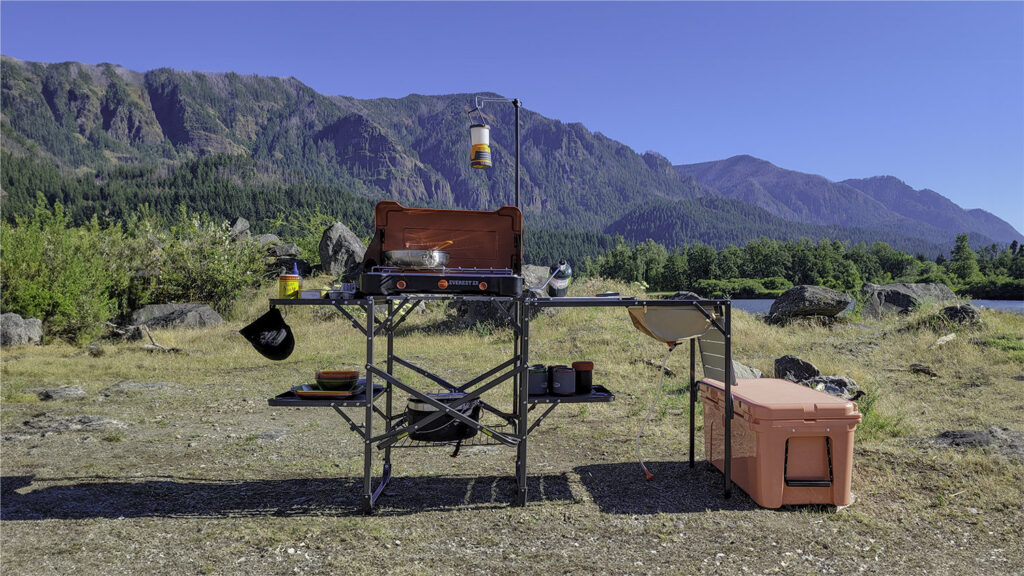


A good camping tent should make camp easier, not become the project you spend the whole weekend managing. The best models give you enough room to sleep and move comfortably, protect you when the weather turns, and set up predictably after a long drive or a late arrival.
Our team has researched and tested more than 50 camping tents from The North Face, Mountain Hardwear, NEMO, REI, Kelty, Marmot, Mountainsmith, Coleman, and others. We have used these shelters in hot sun, cold spring weather, rain, snow, and strong Colorado winds, and we compare them on the same core criteria so the tradeoffs between a huge family basecamp and a compact crossover tent are clear.
Editor’s Note: This guide was updated on October 9, 2026, after revamping individual product reviews and rechecking the ranked field. The current lineup reflects our latest testing and review conclusions.
How We Test Camping Tents
We evaluate camping tents for spaciousness and comfort, ease of setup, weather resistance, durability and quality, and features. That means repeatedly pitching and breaking them down, living in them with realistic sleeping systems and gear, and paying attention to how the design behaves when wind, rain, heat, cold, or limited campsite space make weaknesses more obvious.
Our team has accumulated more than 3,000 nights of camping experience. For this category, we also distinguish CleverHiker-measured weights from listed specifications and judge value separately from the performance metrics.
For more info, check out some of our other most popular gear guides:

#1. Best Camping Tent Overall
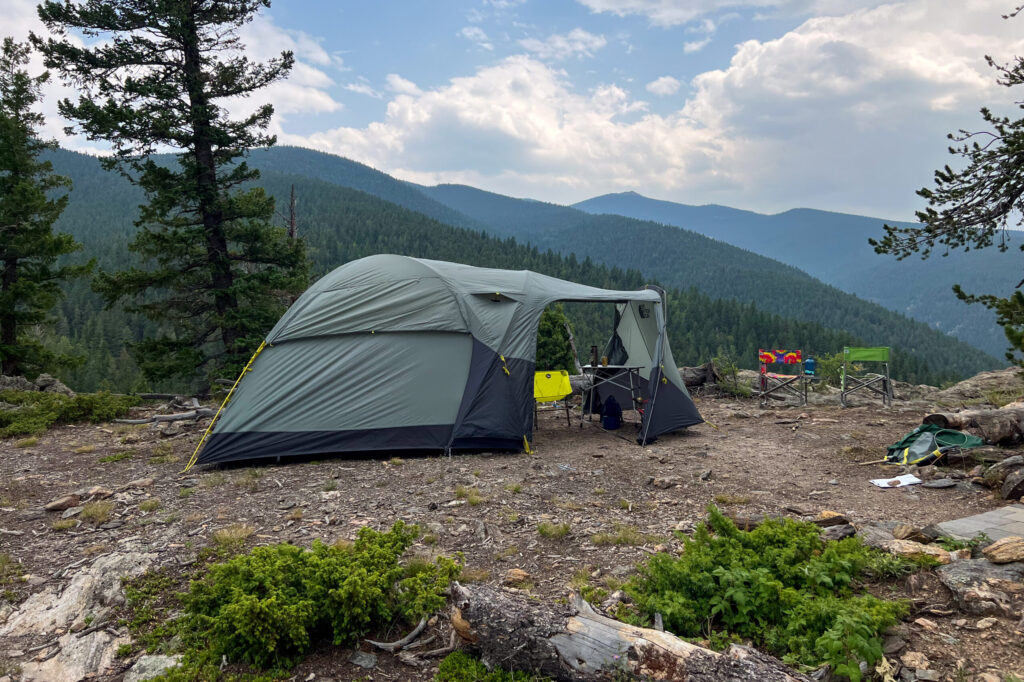
The North Face Wawona 6 is our best camping tent overall because it combines excellent livability, durable materials, useful organization, effective ventilation, and an enormous vestibule better than any other large shelter in the field. For families and groups who want a dependable basecamp with real covered living space, the Wawona is still the tent we would choose first.
Quick Picks for Camping Tents
Check out this quick list of our favorite camping tents, or continue scrolling to see our full list with in-depth reviews.
1. Best Camping Tent Overall: The North Face Wawona 6 ($585)
2. Best Camping Tent for Two: Mountain Hardwear Mineral King 3 ($400)
3. Best Luxury Camping Tent: REI Westward 6 ($549)
4. Best Tent for Easy Setup & High-Quality Materials: NEMO Aurora Highrise 4 ($400)
5. Best Crossover Choice for Camping & Backpacking: REI Half Dome 3 ($399)
6. Best Tent for Internal Storage REI Base Camp 6 ($569)
7. Best Bang for Your Buck: Kelty Wireless 6 ($280)
8. Best Low-Profile, High-Volume Camping Tent: Marmot Tungsten 4 ($449)
9. Best Tent for Light-Sensitive Sleepers Kelty Daydreamer 6 ($270)
10. Best Budget Tent for Casual Campers: Coleman Skydome 4 ($190)
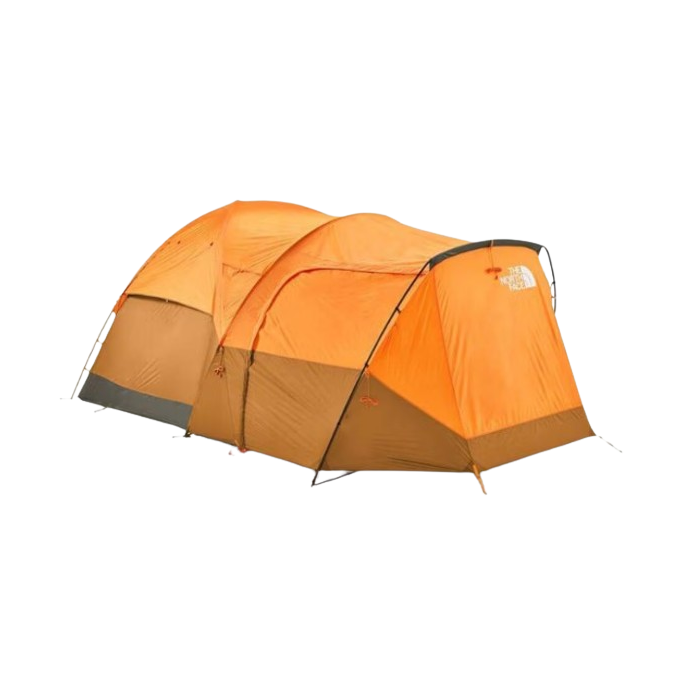
The North Face Wawona 6
Best Camping Tent Overall
CleverHiker Rating: 4.8/5.0
Price: $585
The size we tested feels: Luxurious for 3-4, comfortable for 5, tight for 6
Measured Weight: 19 lb. 7.1 oz.
Dimensions (LxWxH): 116 x 94 x 76 in.
Pros
- Huge front vestibule
- Spacious, tall interior
- Strong poles and durable fabrics
- Excellent ventilation
- Plenty of organization
- Many guyout points
Cons
- Heavy
- Slower than average to pitch
- Footprint not included
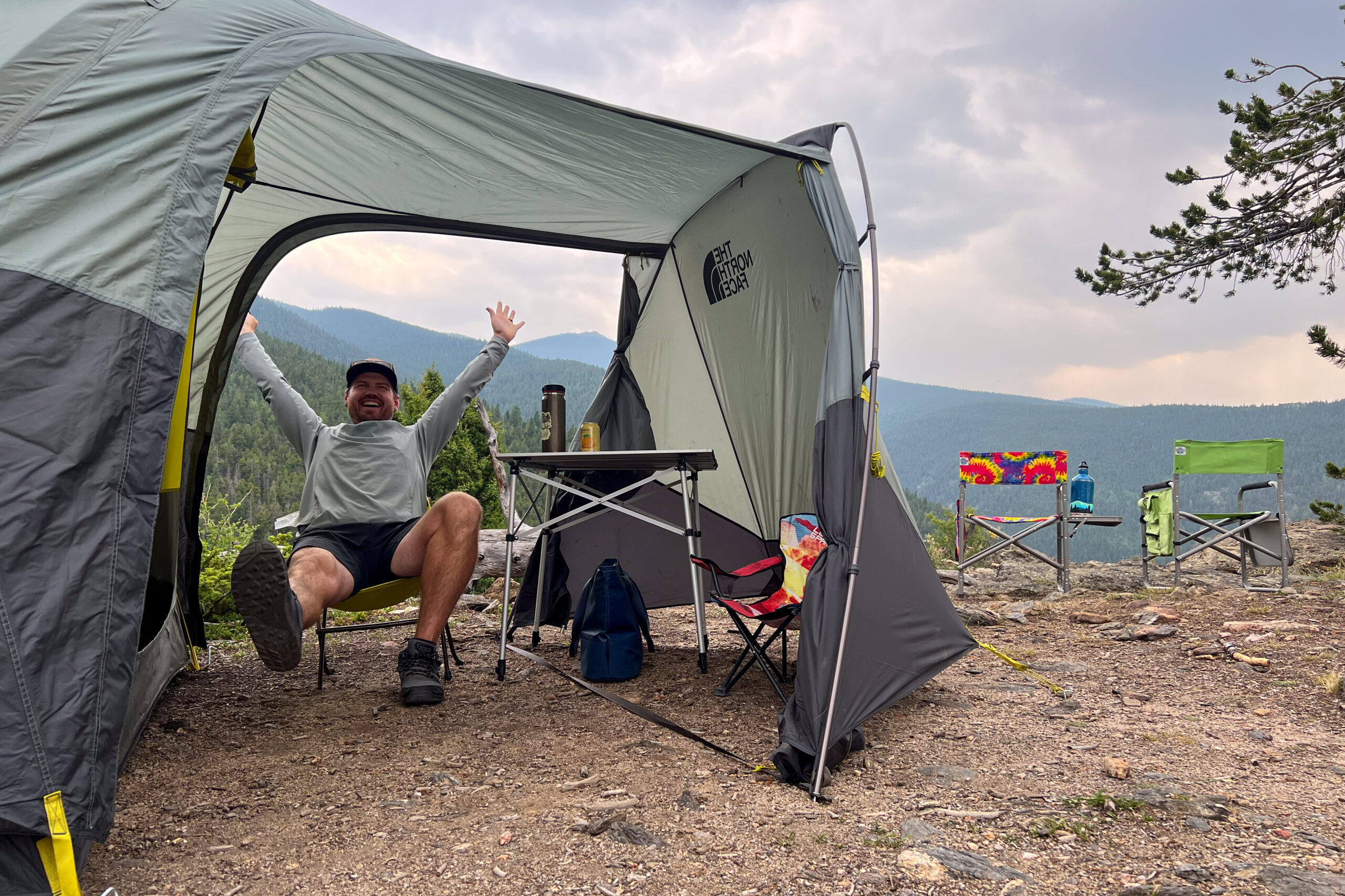
The North Face Wawona 6 earns our top ranking by turning a large six-person shelter into a genuinely useful basecamp. The 75.7-square-foot floor already gives a family room to spread out, but the real difference is the giant front vestibule. In our testing, that covered area worked as a gear closet, bike storage zone, muddy-shoe landing, and sheltered place to sit when weather pushed us under cover.
Inside, a 76-inch peak and tall walls create much more usable standing and changing space than a basic dome. Ventilation is also unusually good for a tent this substantial, and the strong pole structure, durable fabrics, and multiple guyout points have given us more weather confidence than we usually get from a tall family tent.
The penalty is bulk and setup time. This is a true car-camping shelter, and controlling the large body and fly is easier with a second person. Campers who rarely need the huge vestibule can spend less, but families, climbers, bikers, and gear-heavy groups will get real value from the extra protected space.
Mountain Hardwear Mineral King 3
Best Camping Tent for Two
CleverHiker Rating: 4.7/5.0
Price: $400
The size we tested feels: Luxurious for 1, comfortable for 2, tight for 3
Measured Weight: 7 lb. 13.7 oz.
Dimensions (LxWxH): 90 x 68 x 48 in.
Pros
- Lightweight for a camping tent
- Very easy to pitch
- Huge doors
- Excellent ventilation
- Packs down small
- Plenty of interior storage
Cons
- Low ceiling
- Guyline stakes not included
- Difficult to pitch in wind
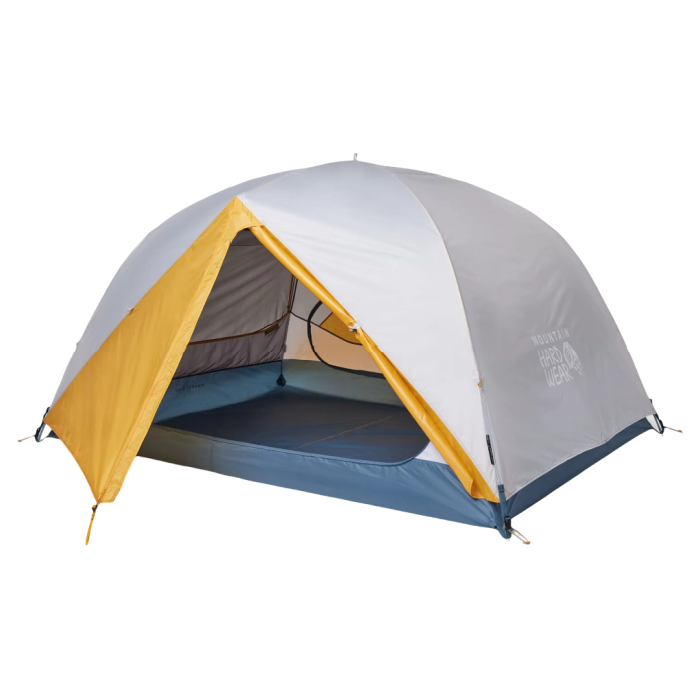
The Mountain Hardwear Mineral King 3 is our favorite option for one or two campers who want more portability than a family-size basecamp tent can offer. At under eight pounds in our measurement, it is easy to move, store, and split between two people, while the large doors, dual vestibules, and efficient floor plan keep it comfortable at camp.
The all-mesh canopy is one of its best warm-weather features. It creates excellent airflow and open views, and the updated fly can roll back for stargazing and deploy quickly when conditions change. The newer storage system and duffel-style carry bag also make day-to-day use easier than on the older version.
You give up standing height. The 48-inch peak works well for sitting up but not for walking around, and three adults will use nearly all the available floor. For couples, solo campers who like extra room, and people who occasionally want a frontcountry tent that can handle a short carry-in trip, the Mineral King is one of the most versatile shelters here.
REI Westward 6
Best Luxury Camping Tent
CleverHiker Rating: 4.6/5.0
Price: $549
The size we tested feels: Luxurious for 2, comfortable for 3-4, manageable for 5-6
Measured Weight: 19 lb. 10 oz.
Dimensions (LxWxH): 120 x 97 x 77 in.
Pros
- Tall, roomy interior
- Huge pole-supported vestibule
- Excellent ventilation
- Large doors
- Color-coded setup
- Useful external storage
Cons
- Partial fly is less protective in prolonged rain
- Fly is awkward to pitch solo
- Carry bag is sloppy
- Guylines are not pre-attached
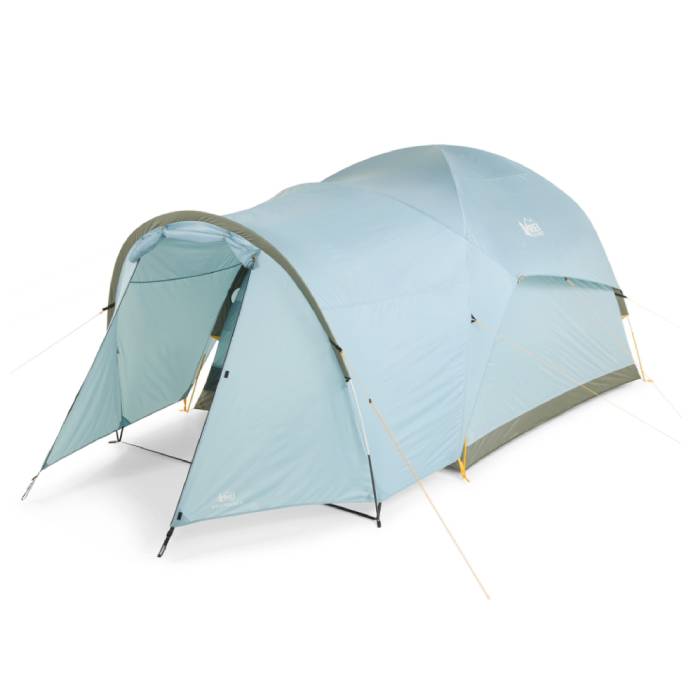
The REI Westward 6 is the tent we would choose when warm-weather comfort matters more than maximum storm coverage. Its 77-inch peak is the tallest in our current lineup, and the upper-wall structure preserves enough volume that tall campers can move around without immediately ducking toward the sides.
A 35.1-square-foot front vestibule expands the usable footprint into a covered porch for chairs, bikes, footwear, and gear. The partial fly is another major part of the experience: it leaves more mesh exposed and helps the interior stay noticeably airier than fully enclosed six-person shelters in direct sun and light wind.
That same design creates the main compromise. Long stretches of wind-driven rain favor a full-fly tent such as the Base Camp 6, and pulling the Westward’s large fly into place is much easier with two people. For mild and moderate three-season camping, though, the combination of standing room, build quality, ventilation, and porch-like living space makes the Westward feel genuinely premium.
NEMO Aurora Highrise 4
Best Tent for Easy Setup & High-Quality Materials
CleverHiker Rating: 4.6/5.0
Price: $400
The size we tested feels: Luxurious for 2, comfortable for 3, tight for 4
Measured Weight: 15 lb. 14 oz.
Dimensions (LxWxH): 100 x 90 x 75 in.
Pros
- High-quality materials
- Fast, intuitive setup
- Large livable space
- Excellent ventilation
- Two doors
- Durable construction
Cons
- Rear door is only half-height
- Carry bag is tight
- Footprint not included
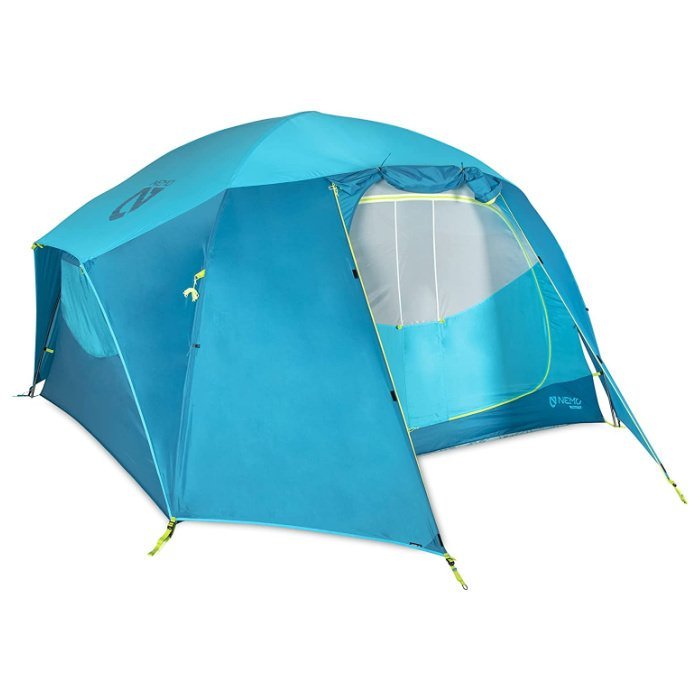
The NEMO Aurora Highrise 4 is a premium small-family tent that gives you real standing height without forcing you into a huge six-person footprint. Steep walls and a 75-inch peak create a bright, open interior, while the giant front door makes loading mattresses and gear much easier than it is through a narrow dome-tent entry.
The Highrise stands out just as much for execution as for space. We like the quality of the fabrics, pole set, zippers, ventilation, and white mesh, and after the unusual pole layout becomes familiar, setup is quick enough to manage solo. Its manageable size also makes it easier to place on tighter campground pads than the largest tents in this guide.
Our biggest annoyance is the tight carry bag, followed by the half-height rear door. Neither changes the recommendation. Couples who want extra room and families of three get an especially good balance of comfort, durability, handling, and weather protection here.
REI Half Dome 3
Best Crossover Choice for Camping & Backpacking
CleverHiker Rating: 4.5/5.0
Price: $399
The size we tested feels: Comfortable for 2, tight for 3
Measured Weight: 7 lb. 2.5 oz.
Dimensions (LxWxH): 90 x 70 x 44 in.
Pros
- High-quality poles and materials
- Quick and easy to set up
- Smooth zippers
- Good ventilation
- Good pockets
- Footprint included
- Enough stakes to fully guy out the tent
Cons
- Low peak height
- Heavy
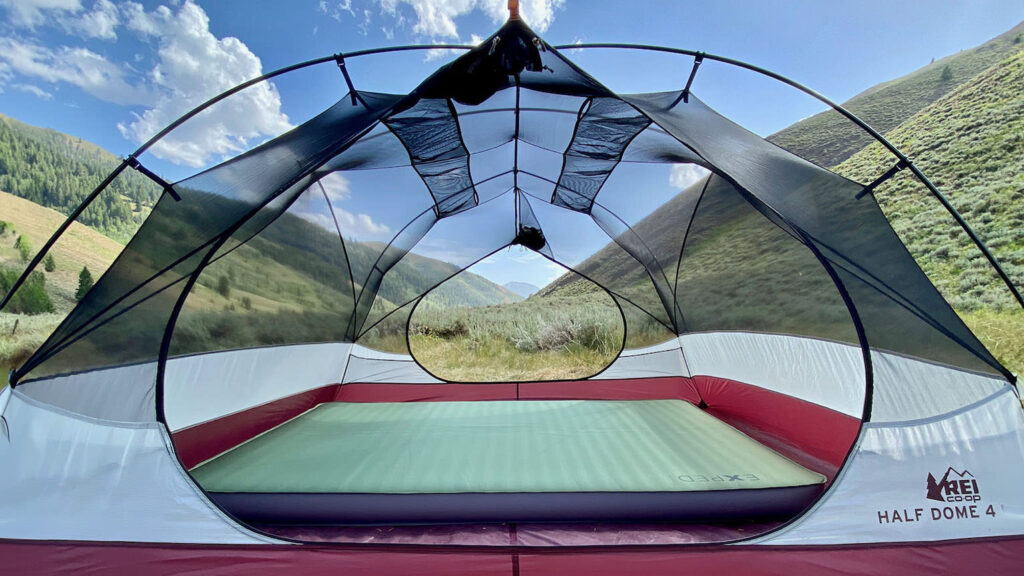
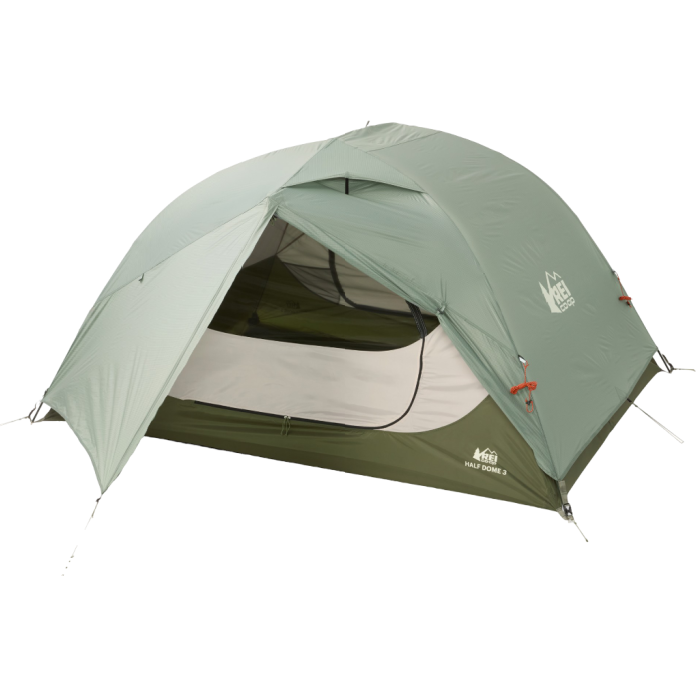
The REI Half Dome 3 stays in this camping lineup because it occupies a useful middle ground between a full-size car-camping tent and a backpacking shelter. At a little over seven pounds, it is not a lightweight backpacking choice by modern standards, but it is dramatically easier to carry and store than most standing-height family tents.
The low 44-inch peak rules out standing, yet the steep walls, broad floor, dual doors, and dual vestibules make the tent comfortable for two people and workable for three when floor space is the priority. Durable materials, a footprint, practical pockets, smooth zippers, and a straightforward setup add to its crossover appeal.
Choose the Half Dome 3 when one tent needs to cover campground weekends and occasional backcountry trips. Campers who never carry their shelter away from the car will get more living space from the Aurora Highrise or Wireless 6, while dedicated backpackers should move to a lighter backpacking-specific tent.
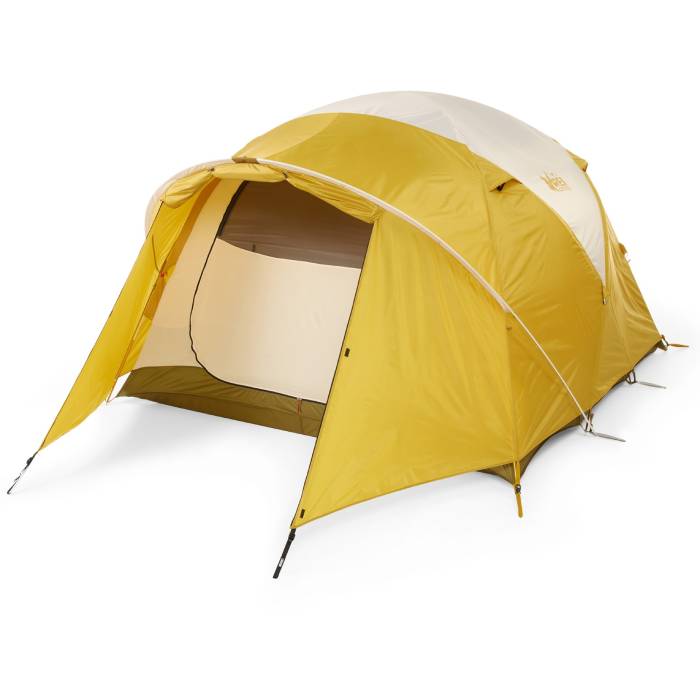
REI Base Camp 6
Best Tent for Internal Storage
CleverHiker Rating: 4.5/5.0
Price: $569
The size we tested feels: Luxurious for 2-3, comfortable for 4-5, tight for 6
Measured Weight: 20 lb. 11.5 oz.
Dimensions (LxWxH): 110 x 110 x 74 in.
Pros
- Exceptional internal storage
- Dual vestibules
- Full-coverage rainfly
- Strong wind performance
- Two large doors
- Excellent vent system
Cons
- Complex setup
- Flexible poles
- Awkward to pack
- Extra stakes needed for full guyout
The REI Base Camp 6 makes the strongest case for families who prioritize protection and organization. Its full-coverage fly, lower dome profile, taped seams, and sleeve-supported structure create a more enclosed shelter than airy six-person designs, and we tested it in high wind at Great Sand Dunes National Park without the properly guyed tent losing its shape.
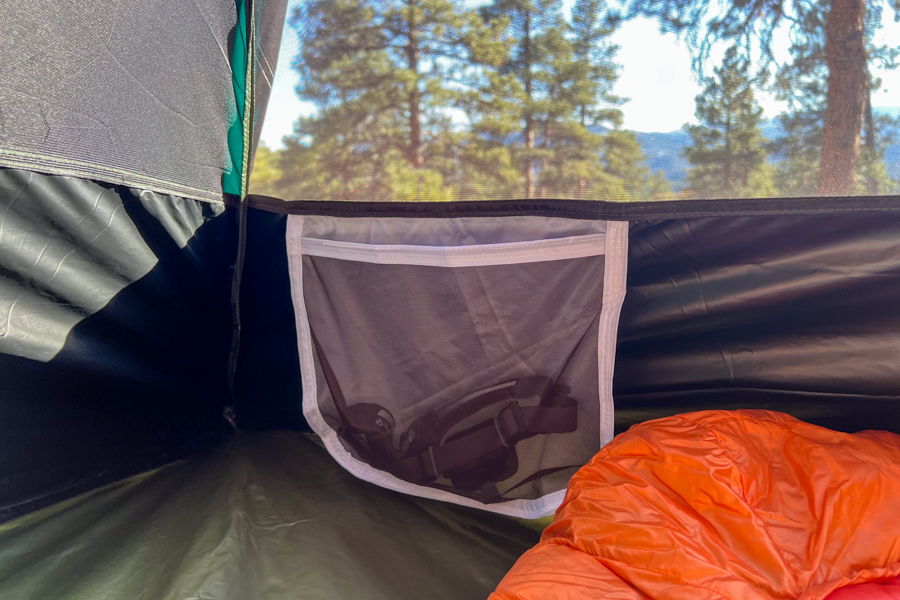
Storage is equally important to the recommendation. Fourteen mesh pockets, a mesh attic, and two vestibules totaling about 44 square feet give headlamps, layers, shoes, and bulky gear dedicated places instead of allowing everything to collect on the floor. That organization becomes more valuable the longer a family stays in one campsite.
The Base Camp is also one of the slowest tents here to pitch. Five poles, several sleeves, a large fly, and numerous stake points make practice worthwhile, and the aluminum poles flex more than we expected from a shelter at this price. If you are willing to trade quick setup for weather protection and exceptional storage, the payoff is substantial.
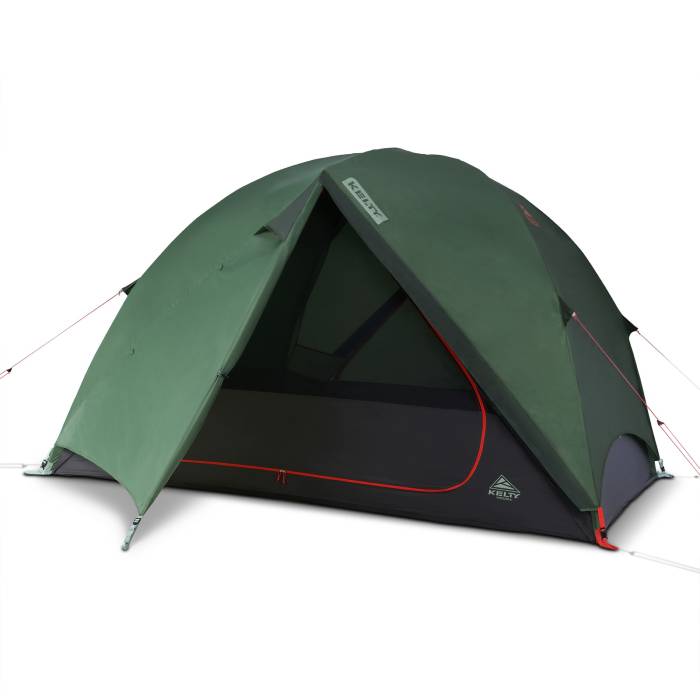
Kelty Wireless 6
Best Bang for Your Buck
CleverHiker Rating: 4.4/5.0
Price: $280
The size we tested feels: Luxurious for 2-3, comfortable for 4, tight for 5
Measured Weight: 18 lb. 15.4 oz.
Dimensions (LxWxH): 118 x 106 x 74 in.
Pros
- Huge interior
- Affordable
- Easy, intuitive setup
- Good standing height
- Pre-attached guylines
- Excellent carry bag
Cons
- Footprint sold separately
- Limited internal storage
- Can feel warm in still weather
The Kelty Wireless 6 gives families more usable space for the money than almost anything else in this guide. Its 86.5-square-foot floor and 74-inch peak provide room for a family of four to spread out comfortably, and two vestibules keep shoes and gear from consuming that interior space.
Kelty’s current version is also easier to live with than the model it replaced. More mesh and kickstand vents improve airflow, pre-attached guylines stash into dedicated pockets, guyout stakes are included, and the Shark Mouth carry bag makes packing unusually painless for a tent this bulky. Color coding and deep pole pockets keep setup approachable for occasional campers.
The lower price still shows in a few places. Internal storage is limited, hot still days expose the ventilation ceiling, and nearly 19 pounds means the Wireless belongs close to the car. For buyers who want a tall family shelter without paying premium-tent prices, those are reasonable compromises.

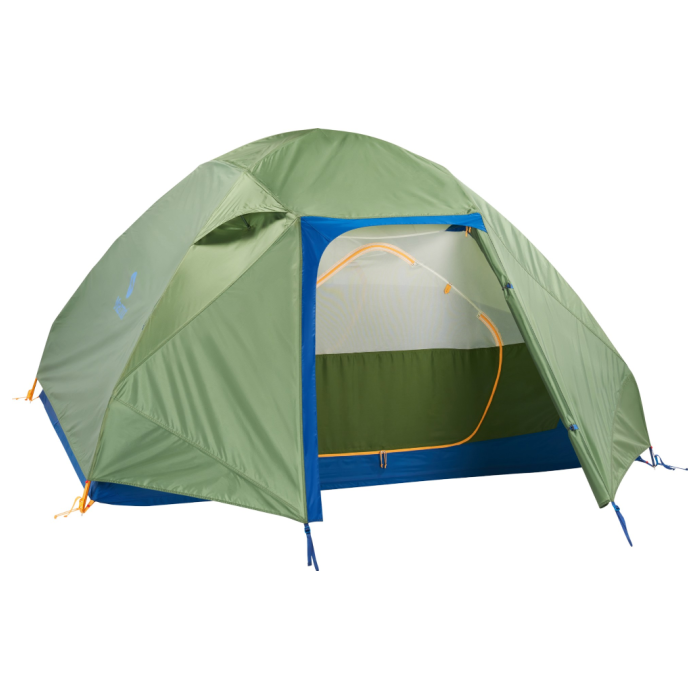
Marmot Tungsten 4
Best Low-Profile, High-Volume Camping Tent
CleverHiker Rating: 4.2/5.0
Price: $449
The size we tested feels: Luxurious for 2, comfortable for 3, tight for 4
Measured Weight: 7 lb. 14 oz.
Dimensions (LxWxH): 93 x 82 x 53 in.
Pros
- Lightweight
- Fast, easy pitch
- Spacious for its height
- Durable materials
- Excellent weather resistance
- Footprint included
Cons
- Low peak height
- Few pockets
- No guylines included
- Not enough stakes included
The Marmot Tungsten 4 is a compact alternative for campers who care more about weather confidence and easy handling than standing room. Its low profile performed very well in wind and rain during our testing, and at just under eight pounds it is much easier to carry from the car to a distant campsite than a 20-pound family tent.
Two brow poles pull the upper walls outward, so the 53-inch peak is more livable than the number suggests. Two people have abundant room, three remain comfortable, and four can fit when maximizing capacity matters more than keeping gear spread out.
The disappointing part is the accessory package. Pocket storage is sparse, guylines are not included, and the supplied stakes do not cover every point. Those are fixable problems, but they reduce the value of an otherwise durable, well-executed shelter. The Tungsten makes the most sense for two or three campers who expect unsettled weather and do not need to stand inside.
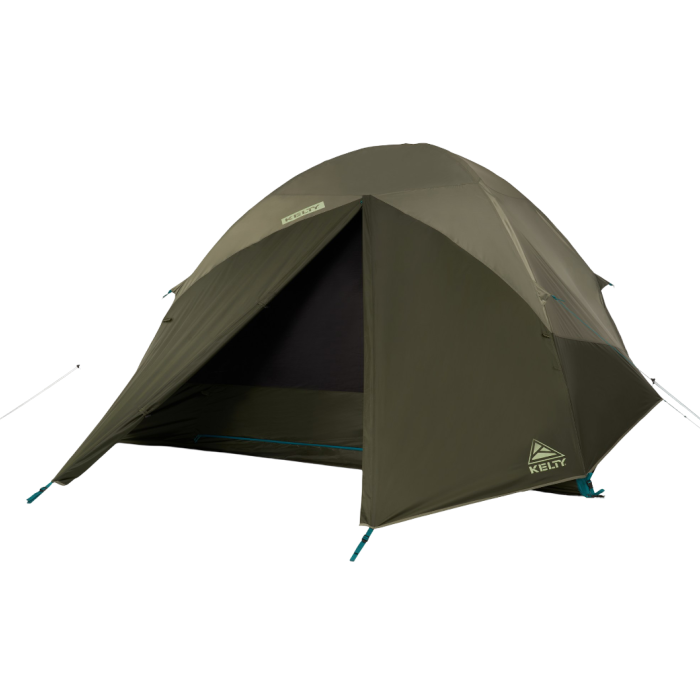
Kelty Daydreamer 6
Best Tent for Light-Sensitive Sleepers
CleverHiker Rating: 4.0/5.0
Price: $270
The size we tested feels: Luxurious for 2-3, comfortable for 3-4, manageable for 5, tight for 6
Measured Weight: 19 lb. 12 oz.
Dimensions (LxWxH): 120 x 107 x 77 in.
Pros
- Darkened fly blocks ambient light
- Large floor area
- Excellent peak height
- Easy setup
- Useful front vestibule
- Mesh body vents well without the fly
Cons
- Poor ventilation with the fly on
- Thin floor material
- Fiberglass poles
- Low-quality stakes
The Kelty Daydreamer 6 is the most specialized tent in this lineup, and that is exactly why it earns a place. Its Twilight Tech fly meaningfully darkens the interior, reducing early-morning sun, campground lighting, and other ambient brightness that can wake light-sensitive sleepers or kids.
It is not a one-feature shelter. The 120-by-107-inch floor is among the largest here, the 77-inch center height gives adults standing room, and the mostly mesh body breathes well when the fly is removed. Setup is also simple enough for occasional family trips.
Installing the dark fly changes the comfort equation. Airflow drops, the interior can heat up in direct sun, and the fiberglass poles and thin floor do not inspire the same long-term confidence as premium competitors. Families who specifically want a darker sleeping environment can reasonably accept those compromises; everyone else will find the Wireless 6 a more balanced value.
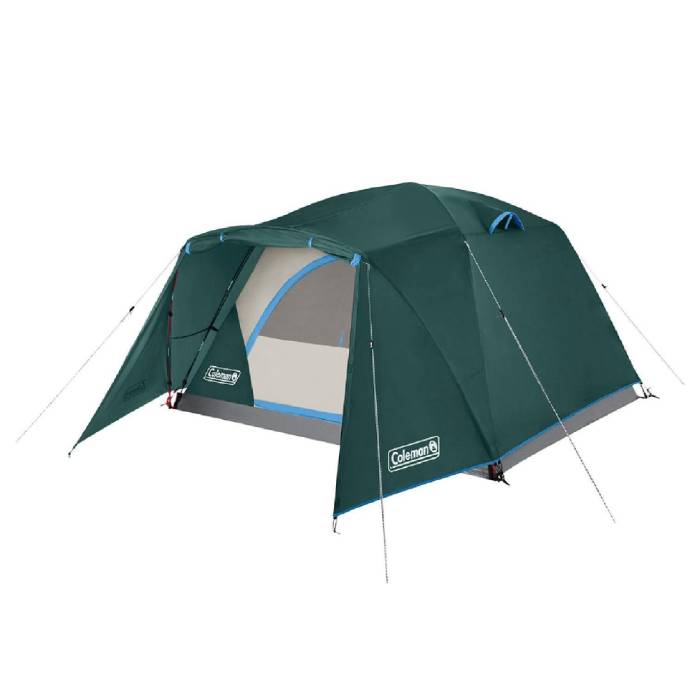
Coleman Skydome 4
Best Budget Tent for Casual Campers
CleverHiker Rating: 3.9/5.0
Price: $190
The size we tested feels: Luxurious for 2, comfortable for 3, tight for 4
Measured Weight: 13 lb. 11.2 oz.
Dimensions (LxWxH): 96 x 84 x 56 in.
Pros
- Affordable
- Integrated poles simplify setup
- Large door
- Functional vestibule
- Full-coverage fly on our tested version
- Useful E-port
Cons
- Low peak height
- Flimsy plastic fly clips
- Only one storage pocket
- Poor ventilation with the fly installed
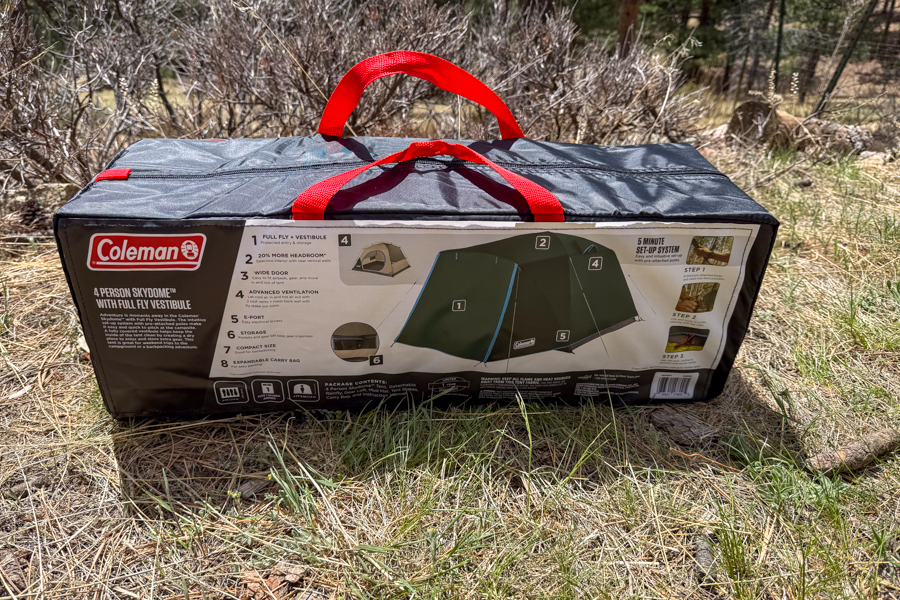
The Coleman Skydome 4 is the simplest path into this guide for new or occasional campers. Integrated poles stay attached to the tent body, fold outward, and slide into the corner sleeves, which eliminates much of the sorting and orientation that makes a first tent setup frustrating.
For two people, the interior is roomy enough for a relaxed weekend. Three can fit comfortably enough, while four uses most of the available floor. The 56-inch peak prevents standing, but a large door and mesh-heavy body keep fair-weather use from feeling unnecessarily closed in.
The low price comes with clear compromises. Plastic fly clips feel light-duty, storage is limited to one pocket, airflow drops sharply with the fly installed, and the carry bag is not something we expect to love after years of hard use. For a few summer trips per year, the Skydome can be all the tent a buyer needs; frequent campers should invest in stronger materials and better long-term livability.
Product Comparison Table
| oSort | Product | Price | Weight | Dimensions (LxWxH) | Comfort | Ease of Setup | Weather Resistance | Durability | Features | 0 |
The North Face Wawona 6 View at REI View at Amazon 
|
$585 | – | 116 x 94 x 76 in. | 4.8 | 3.9 | 4.4 | 4.5 | 4.5 | 1 |
Mountain Hardwear Mineral King 3 View at REI View at Mountain Hardwear
|
$400 | – | 90 x 68 x 48 in. | 4.3 | 4.7 | 4.7 | 4.4 | 4.2 | 2 |
REI Westward 6 View at REI |
$549 | – | 120 x 97 x 77 in. | 4.6 | 4.4 | 4.4 | 4.5 | 4.6 | 3 |
NEMO Aurora Highrise 4 View at REI View at NEMO
|
$400 | – | 100 x 90 x 75 in. | 4.4 | 4.8 | 4.4 | 4.8 | 4.7 | 4 |
REI Half Dome 3 View at REI |
$399 | – | 90 x 70 x 44 in. | 4.3 | 4.7 | 4.4 | 4.7 | 4.4 | 5 |
REI Base Camp 6 View at REI |
$569 | – | 110 x 110 x 74 in. | 4.7 | 4.0 | 4.5 | 4.5 | 4.6 | 6 |
Kelty Wireless 6 View at REI View at Amazon 
|
$280 | – | 118 x 106 x 74 in. | 4.5 | 4.7 | 4.4 | 3.9 | 4.4 | 7 |
Marmot Tungsten 4 View at Marmot |
$449 | – | 93 x 82 x 53 in. | 4.1 | 4.7 | 4.7 | 4.7 | 4.3 | 8 |
Kelty Daydreamer 6 View at REI View at Kelty |
$270 | – | 120 x 107 x 77 in. | 4.6 | 4.6 | 4.3 | 3.9 | 4.3 | 9 |
Coleman Skydome 4 View at REI View at Amazon |
$190 | – | 96 x 84 x 56 in. | 4.1 | 4.0 | 3.6 | 3.6 | 4.0 |
|---|
Analysis & Results
Which Camping Tent is the Best Value?
Value is about performance relative to price, not simply finding the cheapest shelter. The Kelty Wireless 6 stands out for giving families a large interior, useful vestibule space, straightforward setup, and improved ventilation for $280. The NEMO Aurora Highrise 4 costs more, but justifies that jump with better materials, more refined features, and long-term livability for campers who use their tents frequently.
Smaller crossover tents can also be strong values when one shelter fills more than one role. The Mountain Hardwear Mineral King 3 and REI Half Dome 3 both trade standing height for lower weight, easier storage, and enough versatility for campground use plus occasional carry-in trips. At the budget end, the Coleman Skydome 4 makes the most sense for infrequent, fair-weather camping, where its simple setup and lower price can matter more than premium materials or advanced weather performance.
Which Camping Tent is the Most Comfortable?
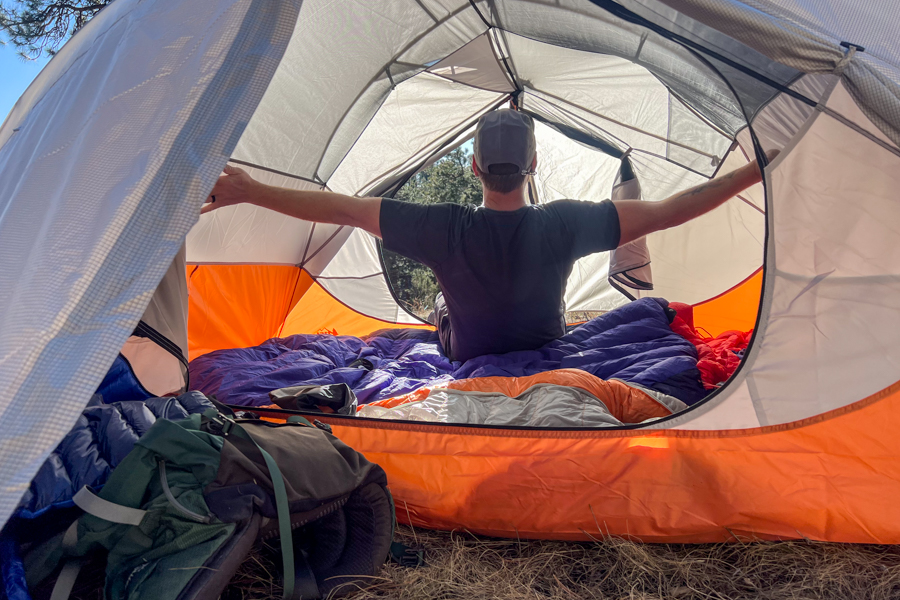
Comfort in a camping tent is not just floor area. Peak height, wall shape, door size, ventilation, vestibule space, and organization all determine whether the advertised capacity feels realistic once sleeping pads and gear are inside.
The Wawona 6 is our comfort benchmark for a family basecamp because its usable space extends beyond the sleeping floor into the enormous front vestibule. The Westward 6 is the best choice for campers who prioritize interior standing room and warm-weather airflow, while the Base Camp 6 turns storage into a comfort feature by keeping gear out of the main living area.
The Aurora Highrise 4 is the strongest smaller option for campers who still want to stand. Its steep walls and 75-inch peak give couples and families of three much of the livability of a larger tent without the same footprint or setup burden. The Wireless 6 and Daydreamer 6 deliver a lot of raw room for less money, with the Wireless providing the more balanced experience and the Daydreamer specializing in a darker sleep environment.
Low-profile tents approach comfort differently. The Mineral King 3, Half Dome 3, and Tungsten 4 trade standing height for lower weight, smaller packed size, and easier handling. The Skydome 4 is comfortable enough for two or three occasional campers but gives up standing room and storage.
Which camping tent is the most DURABle?
The Aurora Highrise 4 stands out for material quality and overall finish. Its poles, fabric, hardware, and construction feel appropriate for a premium shelter, and its manageable size means less fabric is constantly fighting the wind than on the tallest family tents.
The Tungsten 4 and Mineral King 3 are also strong long-term choices. Both use durable materials and low, stable structures, and the Tungsten’s weather-focused build in particular gives us confidence for frequent use. The Wawona 6 combines heavier-duty fabrics and strong poles with the kind of structure we want from a premium family tent.
The Westward 6, Base Camp 6, and Half Dome 3 sit in the durable middle of the field for different reasons: premium-feeling materials on the Westward, weather-focused construction on the Base Camp, and a compact, proven crossover build on the Half Dome. At the value end, durability is part of the trade. The Wireless 6 gives buyers a lot of functional space for $280, while the Daydreamer’s fiberglass poles and thinner floor and the Skydome’s plastic hardware make more sense for moderate or occasional use.
Which Camping Tent is the Most Weather-Resistant?
The Tungsten 4 and Mineral King 3 have the natural advantage of lower profiles. Their shapes present less surface area to wind, and both pair that geometry with full weather coverage and reliable construction. The Half Dome 3 follows a similar logic: it is easier to stabilize than a tall cabin-style tent and remains a good crossover choice when weather performance matters.
Among large family tents, the Base Camp 6 is the most storm-oriented. Its full fly, lower dome shape, taped seams, and sleeve-supported frame prioritize protection over openness, and our high-wind testing at Great Sand Dunes reinforced that role. The Wawona 6 also performs better in bad weather than its size might suggest when it is fully staked and guyed.
The Aurora Highrise 4 occupies the middle ground: it handled variable conditions well in our testing but isn’t as storm-focused as the lower Tungsten or the fully enclosed Base Camp. The Westward 6 sits on the other side of the tradeoff. Its partial fly is a major reason it ventilates so well in warm conditions, but it gives up protection during prolonged or wind-driven rain. The Wireless 6 offers respectable campground weather performance for the price, while the Daydreamer and Skydome are better understood as fair-weather-oriented value shelters.
Which Camping Tent is the Easiest to Set Up?
The Aurora Highrise 4, Mineral King 3, Half Dome 3, Tungsten 4, and Wireless 6 are the easiest group to recommend for campers who dislike complicated setup. They use clear structures and helpful orientation cues, and their bodies are manageable enough that a single person can reasonably learn to pitch them without turning camp arrival into a team exercise.
Size becomes the primary obstacle as tents get larger. The Westward 6 is logically designed, but height makes the fly awkward alone. The Wawona 6 has more fabric and pole structure to manage.
The Base Camp 6 is the most involved of the premium family tents because its weather-focused structure uses more poles, sleeves, stake points, and fly coverage. It becomes easier after practice, but it is the tent in this lineup we most strongly recommend pitching at home before the first trip. At the budget end, the Daydreamer 6 is straightforward despite its size, and the Skydome 4 uses integrated poles specifically to remove much of the sorting and orientation that frustrates first-time campers.
Which camping tent has the best FEATURES?
The Wawona 6 has the most consequential single feature in the category: its huge front vestibule. That covered zone changes how a group can use camp by moving bikes, chairs, bins, wet gear, and social space outside the sleeping area while keeping them protected.
The Base Camp 6 is the organization leader. Fourteen pockets, an attic, two vestibules, large doors, and adjustable ventilation make it the tent for families who want a place for everything. The Westward 6 adds a similarly useful porch concept with a 35.1-square-foot vestibule, external storage, big doors, and warm-weather airflow.
The Daydreamer’s Twilight Tech fly is the most specialized feature because it solves a specific sleep problem rather than improving general shelter function. The Wireless 6 pairs practical guyline storage with one of the easiest carry bags in the category. The Mineral King 3 and Aurora Highrise 4 focus on smaller details—door storage, ventilation, carry systems, and practical pockets—that make repeated use smoother. The Half Dome 3’s included footprint and complete guyout hardware reduce the accessories a buyer needs to add later; the Tungsten 4 is comparatively sparse, and the Skydome 4 keeps features intentionally basic to hold down cost.
How to Choose a Camping Tent
What size tent do I need?
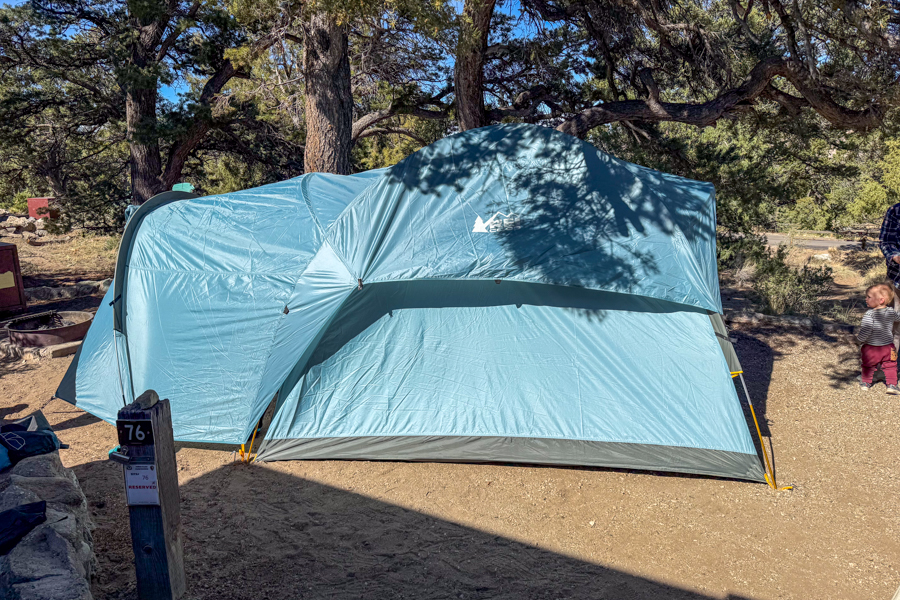
Treat the advertised capacity as the maximum number of sleepers, not a comfort recommendation. For most car campers, moving up at least one capacity size creates room for clothing, pets, bags, and the inevitable spread of small items that happens after a few hours at camp.
A couple who wants a relaxed setup will often be happier in a three- or four-person tent than a two-person model. Families should think about how much floor area remains after mattresses are inflated, not only how many sleeping pads can technically be arranged side by side.
How Much Does Peak Height Matter?
Peak height matters most when you expect to spend time inside the tent while awake. Standing to change clothes, managing kids, waiting out rain, or organizing gear is much easier in a tent around six feet tall or more.
Height also has a cost. Tall walls catch more wind, large structures usually weigh more, and oversized flies are harder to manage alone. Campers who mostly enter the tent to sleep can often gain weather stability and portability by choosing a lower shelter.
How many doors do I need?
For more than two campers, multiple doors make a noticeable difference. Separate entries reduce nighttime climbing over sleeping partners and make it easier to divide vestibule storage between people.
Door size matters too. Large mattress systems, cots, and family gear are easier to load through broad openings, while small doors can make an otherwise roomy tent frustrating to use.
How Important is Ventilation?
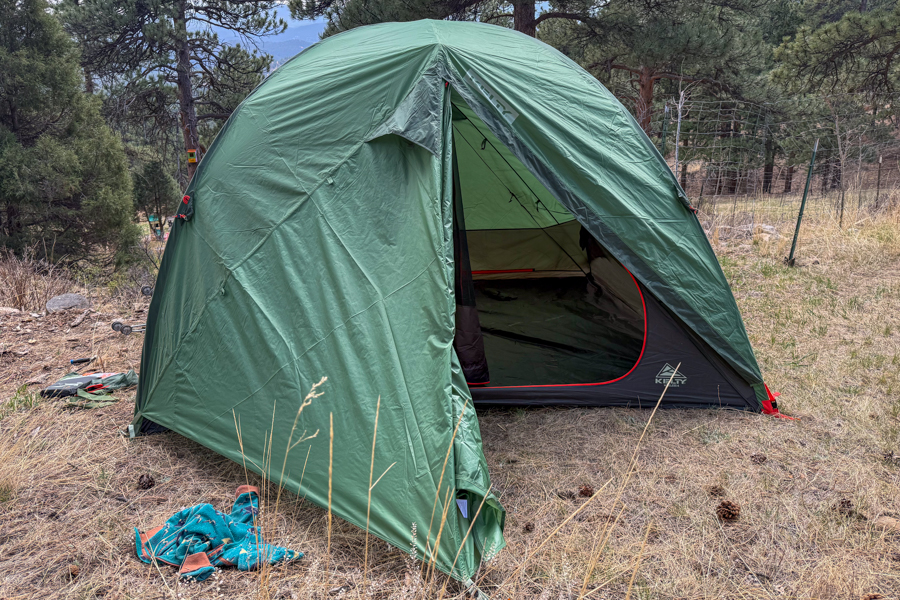
Ventilation controls both temperature and condensation. Mesh-heavy bodies feel much better in hot weather, but a tent also needs ways to keep air moving after the rainfly is installed.
Look for kickstand vents, protected openings, adjustable windows, and enough separation between the fly and tent body to create airflow. A tent that only breathes well with the fly removed may become stuffy exactly when rain forces you to close it up.
How Much Should I Care About Setup?
Setup matters more when you camp frequently, arrive after dark, move sites often, or expect to pitch alone. Color coding, captured pole ends, clear sleeves, simple hubs, and pre-attached guylines can remove small frustrations that add up over a season.
Large family shelters almost always require more work. If a complicated structure buys weather protection or living space you genuinely use, the trade can be worthwhile. If you mostly take quick weekend trips, a simpler tent may improve the experience more than another few square feet of floor area.
Do I need a Fully Waterproof Camping tent?
For normal three-season camping, we want a seam-sealed shelter with a reliable rainfly and a floor that keeps runoff outside. Full-coverage flies generally provide more protection in prolonged rain, while partial flies often improve warm-weather airflow.
Waterproofing is also maintenance, not a permanent condition. Seam tape, coatings, and durable water repellent finishes age. A good tent can often be restored with cleaning, seam work, or coating maintenance rather than replaced at the first sign of reduced performance.
Do I need VESTIBULES or AWNINGS?
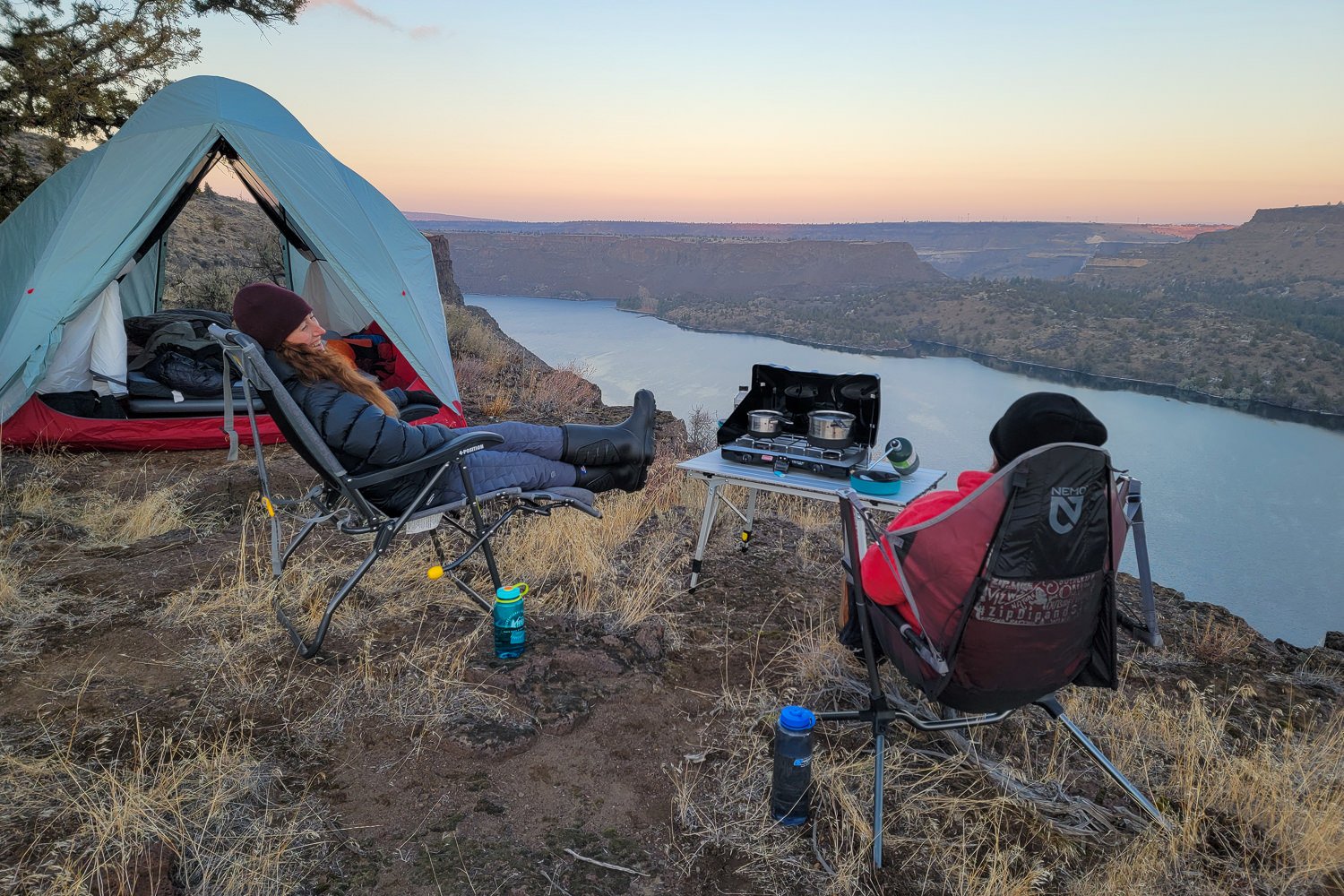
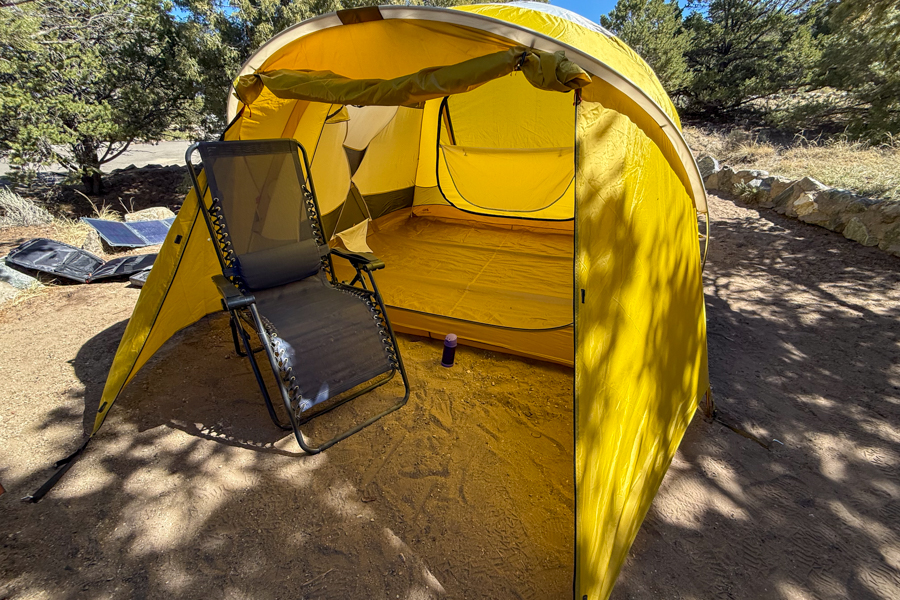
Vestibules keep wet shoes, packs, chairs, and bulky gear out of the sleeping area without leaving them exposed. For families, a large vestibule can be as valuable as extra floor area because it creates a transition zone between dirty camp and the interior.
Small vestibules are mainly storage. The largest designs become covered living areas where people can sit or organize gear during light weather.
How Much Does PACKED SIZE Matter?
Packed size is secondary to performance for most car campers, but it still affects how easy the tent is to store, load, and carry from the parking area. A 20-pound six-person shelter can be excellent at camp and annoying everywhere between the garage and the tent pad.
People with small vehicles, limited home storage, walk-in campsites, or mixed camping and backpacking use should pay much more attention to packed size and weight. That is where crossover models make sense.
What do SEASON RATINGS mean?
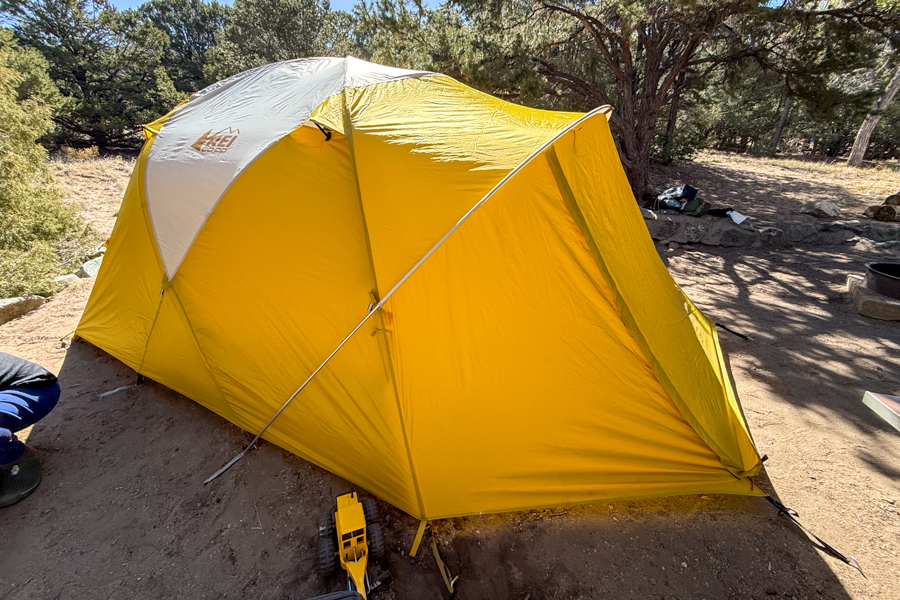
Most tents in this guide are three-season shelters built for spring, summer, and fall. They balance mesh and ventilation with enough fly coverage and structure for typical rain and wind.
More weather-focused three-season tents use fuller rainflies, lower shapes, and stronger structures that extend their useful window into colder shoulder-season conditions. True four-season tents are a different category, with less ventilation and more structure for snow loading and severe wind.
What’s the Difference Between Packaged Weight & Minimum Weight?
Packaged weight includes the tent body, fly, poles, stakes, stuff sacks, and the accessories sold with the shelter. That is the number most useful to a buyer deciding what the complete tent actually weighs.
Minimum or trail weight usually strips away some accessories and is defined differently by different manufacturers. For camping tents, we prefer the complete packed figure because that better reflects what most people will actually carry from the car to the campsite.
Do I Need a Footprint?
A footprint can reduce abrasion and protect the tent floor from sharp or dirty ground. It is most useful when the tent uses a thinner floor fabric, the campsite is rough, or you want to preserve an expensive shelter for many seasons.
The footprint should be slightly smaller than the tent floor. Material that extends beyond the edge can collect rain and funnel it underneath the shelter.
Why are STAKES & GUYLINES important?
Stakes and guylines are part of the tent’s structure, not optional storm decorations. Tensioning the shelter correctly increases usable interior volume, keeps the fly separated from the body, and gives poles more support when wind loads the tent.
Several camping tents do not include enough stakes for every guyout point. If a shelter depends on a fully guyed pitch for rough-weather performance, add the missing stakes before the trip instead of discovering the shortage during a storm.
Why Trust CleverHiker
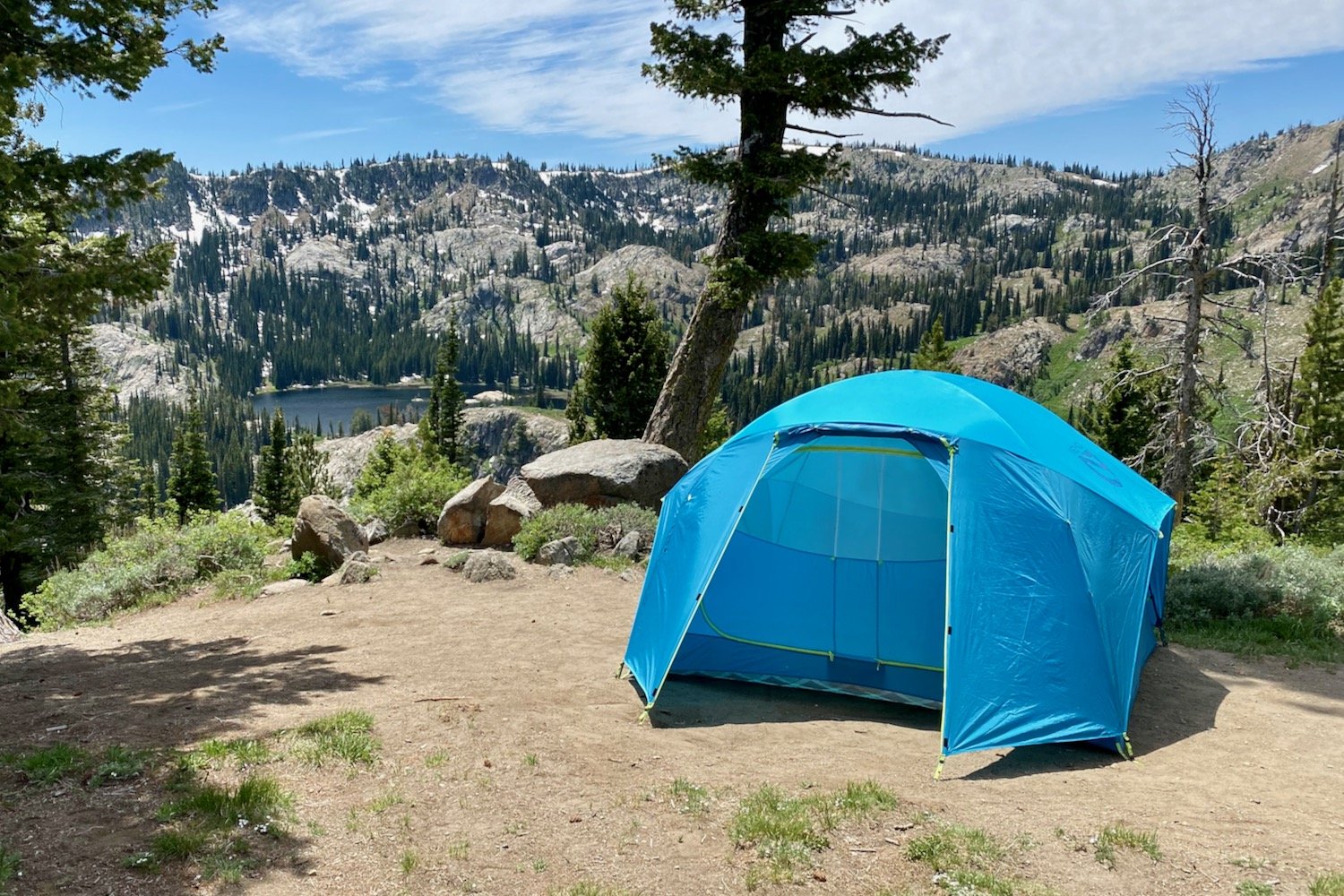
CleverHiker’s team has collectively spent more than 3,000 nights camping and backpacking. Our camping-tent testing includes repeated use in Colorado campgrounds, exposed sites, high-desert wind, spring cold, summer heat, rain, and snow, along with years of experience comparing how different shelter designs age and behave in real trips.
We do not use manufacturer claims to create CleverHiker judgment. Objective specifications help explain a product, but recommendations come from our testing evidence, category comparisons, and the conclusions recorded in our current reviews and ranking process.
Testing Methodology
How do we Evaluate SPACIOUSNESS & COMFORT?
We consider floor dimensions, practical sleeping capacity, peak height, wall shape, shoulder room, door access, vestibule space, ventilation, and organization. A tent does not earn a strong comfort result merely because the manufacturer assigns it a high capacity.
How do we Evaluate EASE OF SETUP?
We look at how quickly the structure makes sense, whether one person can manage it, and how many points in the process create avoidable friction. Color coding, captured pole ends, intuitive hubs, sleeves, clips, fly orientation, guyline management, breakdown, and carry-bag design all matter.
How Do We Evaluate Weather Resistance?
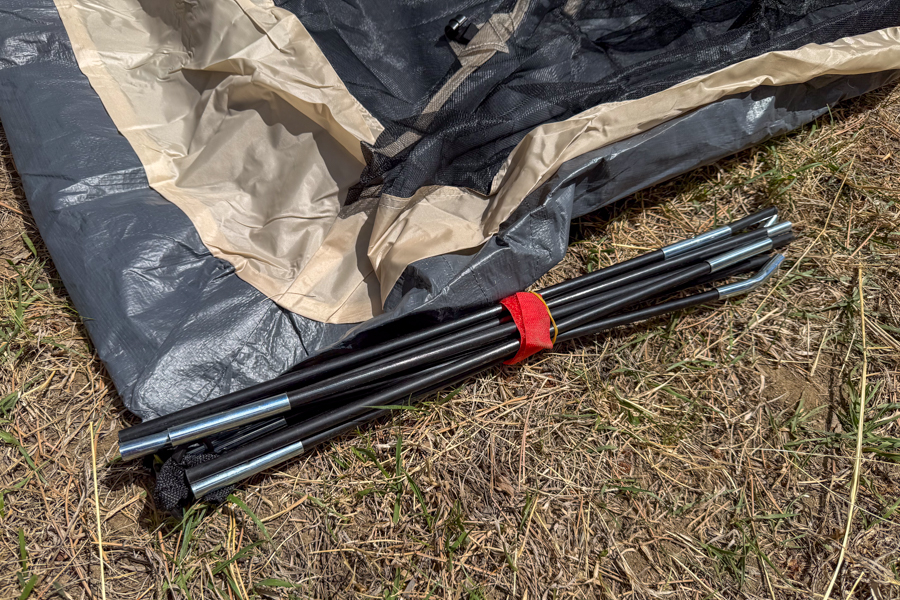
We assess fly coverage, seam construction, floor protection, ventilation in wet conditions, pole structure, height, geometry, guyout support, and real use in wind and precipitation. Weather performance is the complete system, so a good waterproof fabric cannot compensate for a structure that is difficult to stabilize.
How do we Evaluate DURABILITY & QUALITY?
We pay attention to pole material and behavior, fabric weight, zippers, clips, buckles, stitching, seam work, mesh, stress points, storage components, and how the shelter holds up to repeated pitching and packing. Premium pricing raises our expectations for both materials and execution.
How Do We Evaluate Features?
Features only matter when they make camp better. We consider vestibules, pockets, gear lofts, vents, doors, included footprints, guyline systems, carry bags, lighting pockets, E-ports, and other additions based on usefulness rather than quantity.
Conclusion
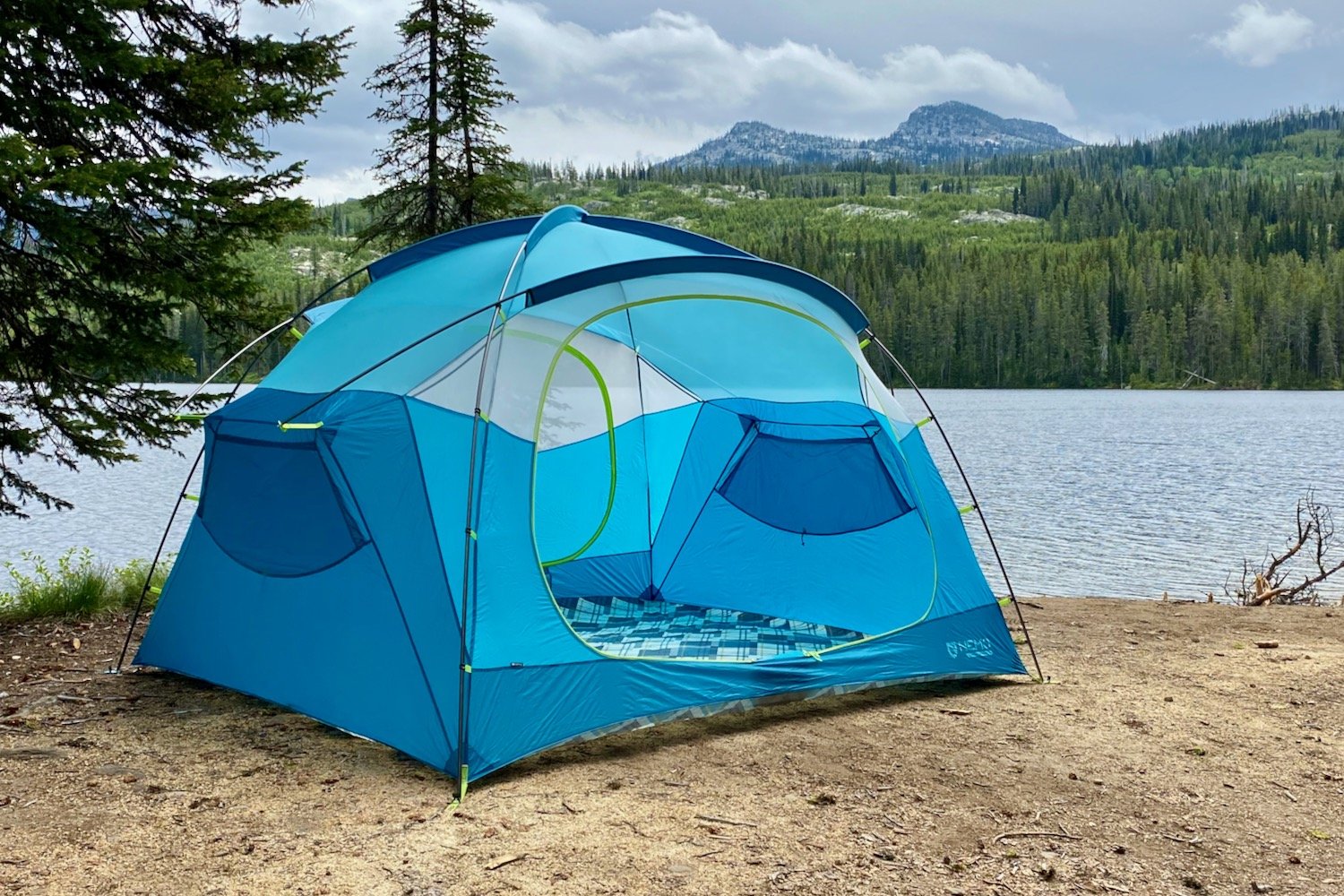
The best camping tent is the one that matches how you actually camp. Start with realistic sleeping capacity, then consider how much standing room, vestibule space, ventilation, storage, and weather protection your group needs. Frequent campers should also put more weight on durable materials and a setup process they can repeat comfortably after long drives or late arrivals. Focus on the balance of comfort, durability, weather resistance, setup, and packed bulk that fits your trips rather than buying purely by capacity or cost.